From the classroom to the farm to the sales ring, students with Lakeland College’s Student-Managed Farm – Powered by New Holland (SMF) are making connections that matter.
During their second year of the animal science technology program, students are given the option to complete an industry practicum or take the reins of one of the SMF’s units, which include dairy, commercial beef, equine, extensive grazing and purebred beef.
For Kay Lee Zbudovski and Brooklyn Van Sickle, choosing the purebred beef unit was about continuing a family cattle legacy while looking to the future of the industry with an eye on advancing genetics.
“On the purebred unit, there are 16 of us working together to run our purebred operation,” explains Van Sickle, who comes from a purebred operation near Bowden, Alta. She’s majoring in livestock science to gain experience in different livestock species. She is one of this year’s Round Up Sale and marketing coordinators on the unit.
“As a collective, we make all decisions impacting the herd together, working together with common goals. We rely on each other’s experience and what has or hasn’t worked on our home operations to advance the herd here.”
“We handle anything involving the purebred herd, like doing herd checks, calving checks, vaccinations,” says Zbudovski, this year’s PR and show team coordinator, who’s majoring in beef science and hails from a commercial cow-calf and horse operation near Camrose, Alta.
Prioritizing genetics
Students involved in the genetics and breeding side of the SMF look at breed books and animal pedigrees, bringing in frozen genetics from sires across Canada and the USA to diversify the herd’s genetics through artificial insemination.
“Most of our work revolves around our bulls,” Zbudovski explains. “That’s where most of our commercial producers come in, because they’re looking for purebred sires. We are providing the commercial industry with bulls that have whatever traits they’re looking for. We have red and black Angus here, so we’re breeding Angus for producers looking to incorporate those genetics into their herds.
“For our females, we want to keep putting out the genetics that we’re producing here into other people’s herds, though this year, we’re keeping a lot of our heifers back to try to grow our herd.”
Each year, the unit’s hard work is on display at the Round Up Sale, where they collaborate with the other SMF units to host industry representatives and producers on Vermilion campus and online for an annual livestock sale. This year, the purebred unit hopes to have 12 purebred bulls on offer at the sale on March 28, while other units will have commercial heifers and equine geldings for auction as well.
“Success for the year is measured by how much our bull sales are at the end of the year at the Round Up,” says Zbudovski. “It’s also measured by what kind of calves our cows are putting out on the ground, how much improvement we’re making in the industry and how we’re keeping up with trends throughout the black Angus industry.”
A Lakeland first
Genetics is all about diversification. This year, the purebred SMF is diversifying their approach to sales as well, after a member of the SMF brought up the idea of entering a heifer into a consignment sale. It’s something Lakeland hasn’t done before.
“It was a way for us to put our genetics out there and our college name as well,” Zbudovski explains. “It was the first every consignment sale that’s ever been done at the college, so we were making a name for ourselves, making a little bit of history.”
A consignment sale differs from what happens at the Round Up Sale because it involves a variety of producers, Zbudovski explains.
“When it’s just one farm, like at our Round Up, it’s just our genetics and what we’re bringing to the table. At a consignment sale, there are a bunch of other producers and we come together as an industry.”
The SMF unit reached out to the Northern Angus Select Sale, and a representative from the sale helped them choose a heifer that would do well. After considering the options in the replacement heifer pen, one was chosen – OAV First Class 2N, or 2N for short.
“2N is one of our best heifers,” Zbudovski says. “She’s got power, dimension, a great temperament, and a really nice pedigree behind her. We would have been happy to keep her but we’re very proud to be able to put her out into the industry to continue our legacy.”
They worked hard to prepare 2N for the sale, bringing them closer together as a team and giving them something to celebrate when the sale was a success.
“It was a great experience to try something new and expand our horizons,” says Van Sickle. “We learned how to be involved in a consignment sale and all the different things that go into it. We bonded as a team because we all had to work together to make it a success.”
That’s the true measurement of a successful purebred SMF unit, she says.
“Having a successful year is not only about the money we make at the Round Up,” she says. “It’s having customers that come back and love our products. It’s meeting our goals as a team. And it’s just everybody learning something new throughout the year.”
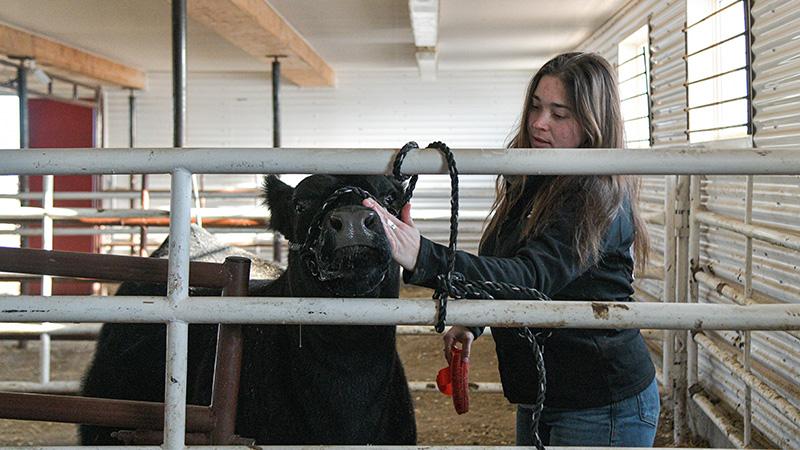

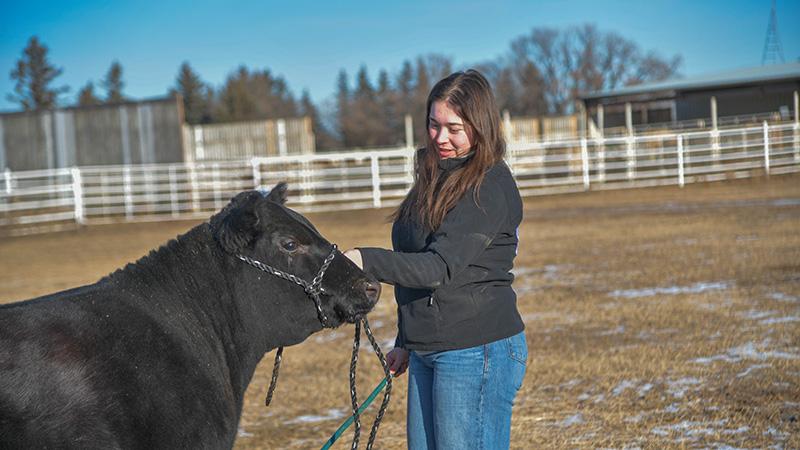
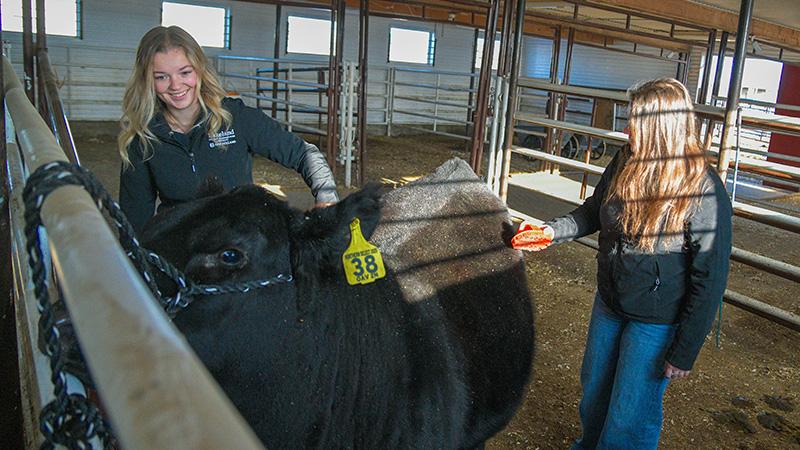
Photos: 1. Kay Lee Zbudovski with 2N in the cow/calf barn. 2. Brooklyn Van Sickle and Kay Lee Zbudovski interact with one of the friendliest young bulls that will be up for sale at the Round Up Sale in March. 3. Kay Lee Zbudovski uses her 4H skills to show off 2N. 4. Brooklyn Van Sickle brushes 2N, the heifer that the purebred SMF unit sold at consignment.