University Transfer: Learning in Action
University Transfer
Contact Us
Jessica Amundrud
University Transfer Enrolment Specialist
780 871 5429
Ask me your questions
Put theory into action
Classrooms and labs are what you expect in university. And you’ll spend time in both when you take university transfer at Lakeland.
You’ll benefit from having more elbow room and up-to-the-minute technologies in our labs. Put theory into action, developing key skills that will help you complete your degree.
Popular routes
Two of our most popular transfer routes are education and science.
Depending on your courses and the degree you're pursuing, you could find yourself:
- creating an interactive math game and sharing it at a grade 3 Math Fair
- exploring movement activities with elementary and secondary aged students in their school gym
- experiencing educational settings in Mexico

 The course is called higher arithmetic, but one of its projects involves grade three
students.
The course is called higher arithmetic, but one of its projects involves grade three
students.
One, sometimes two, math fairs are held at local schools for prospective teachers to learn more about how youngsters learn math.
What did the UT students learn? Read about their experiences in More Than Fun and Games at Math Fair.
 PEDS 293 is a study of developmentally appropriate movement activities for children.
As a student, you'll try out some of those activities with your classmates. Then you'll work with children either at their school or in the Lakeland gym.
It's all part of learning how important physical education is to elementary-aged students and to gain insight into different levels of physical development.
PEDS 294 covers secondary-aged students.
Lakeland's biology, physics and chemistry labs are state of the art. Why not take a virtual tour of the Lloydminster campus, or come and visit yourself.
While you might equate science with microscopes and test tubes, those aren't the only kind of labs our science students have. Local parks and geographic formations are two field lab locations.
See the photo gallery that covers both indoor and outdoor labs:
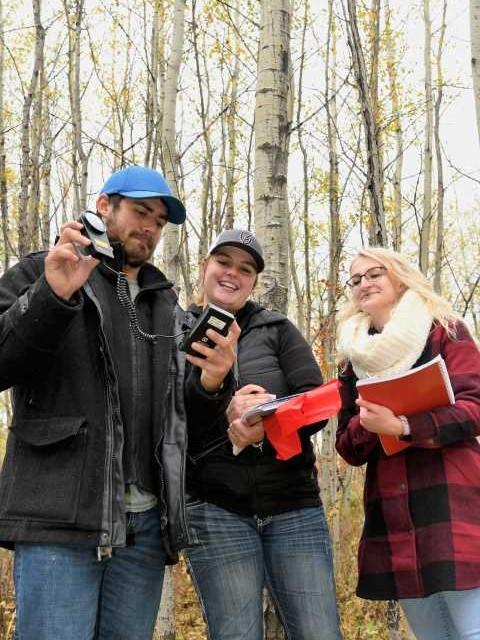
BIO 208 ecology students using a photometer (light meter) in the deciduous forest of Bud Miller Park.
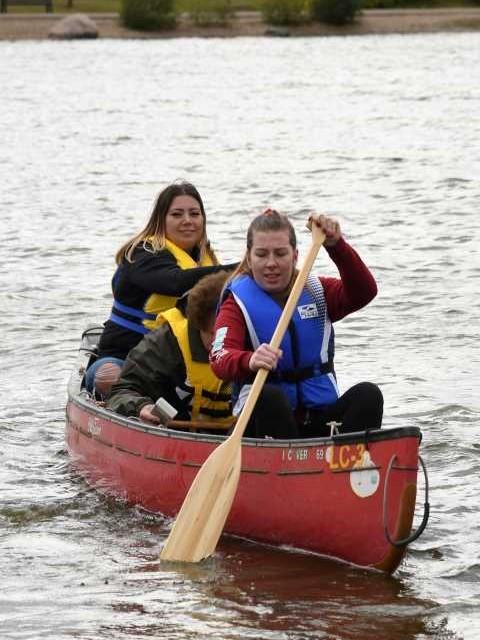
BIO 208 ecology students canoe out on the lake at Bud Miller Park to measure dissolved oxygen, temperature and other parameters in the water column.
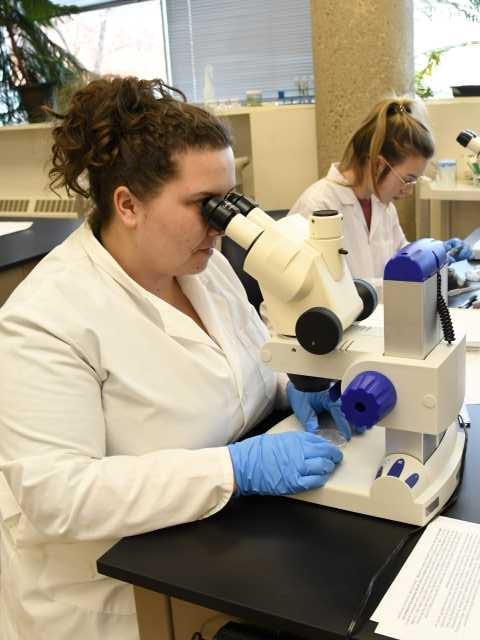
BIO 108 student counts brine shrimp with a stereomicroscope during an ecology lab experiment.
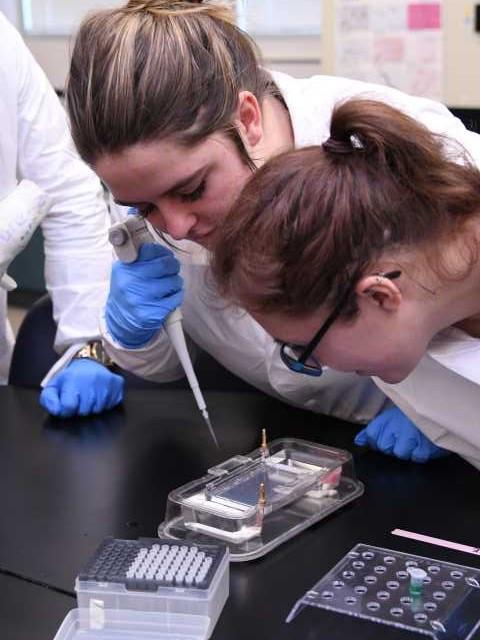
In BIO 207, genetics lab students use a micropipette to load a bacterial DNA sample in an agarose gel.
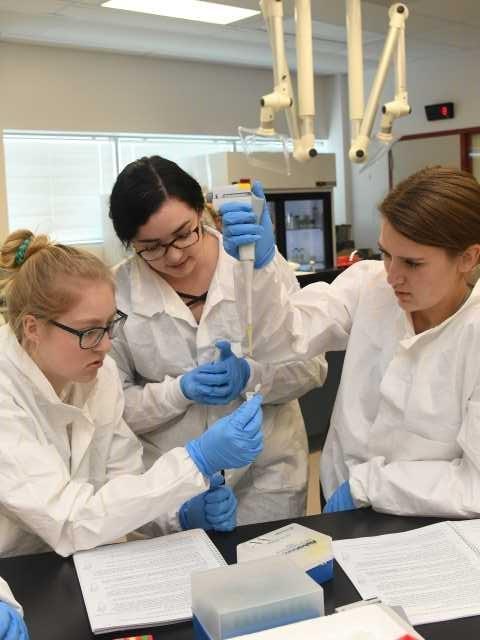
Cell biology lab procedure called a mini plasmid prep where small molecules of DNA called plasmids from E.coli cell are extracted and purified.
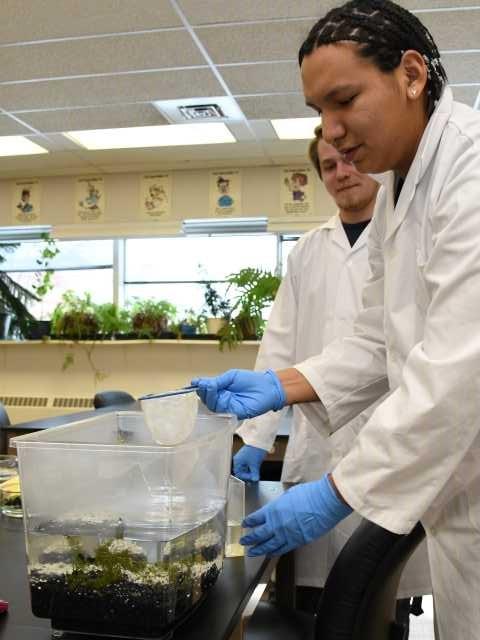
BIO 108 student sets up an aquarium to investigate aspects that contribute to snail habitat preferences.
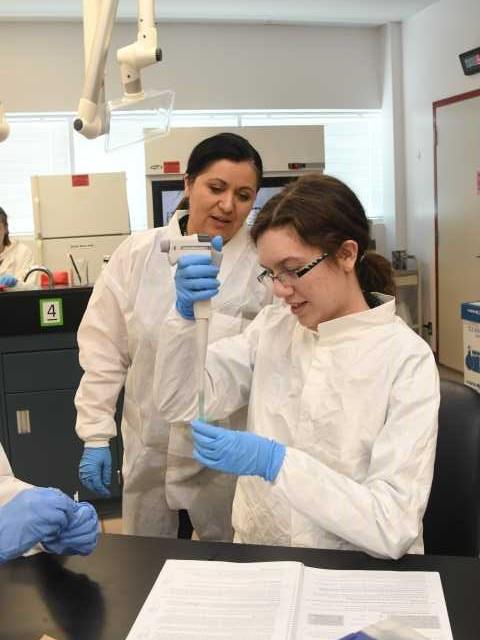
A student in BIO 107 uses a micropipette to transfer a small volume of reagent between vessels.
Experiences

An annual field trip to nearby Lea Park allows Earth Sciences students to see erosion of a Cretaceous-aged formation by the Vermilion River.
Students also take field measurements and collect samples from the river to determine its sediment capacity.

Chemistry students performed the acid-catalyzed dehydration of cyclohexanol to produce cyclohexene.
Cyclohexanol is a colorless thick liquid or sticky solid used to make nylon, paint and varnishes or a solvent to degrease.
Their goal was to make an alkene, a hydrocarbon containing a carbon-carbon double bond.
Cyclohexen is a colourless liquid used in a number of manufacturing processes.

For Bio 108 Ecology Christina Crews did an independent research project. She learned more than she expected by comparing two different areas of Bud Miller park's forest:
“You do learn in the classroom but it's not the same as actually going out, doing hands-on lab work and using the techniques that you are learning."
 Everyone takes English
No matter your degree path, you'll need to take English.
At Lakeland, it isn't a chore. From work groups to acting out a Shakespeare play, you won't just be reading.
In Introductory English Literature, you might study Shakespeare's comedy, A Midsummer Night's Dream. If so, you won't just read the play. You'll do exercises to examine how the text relates to physical drama and the meaning of the scene.
And in the case of comedy, you'll focus on the importance of the audience in interpreting the humour.


